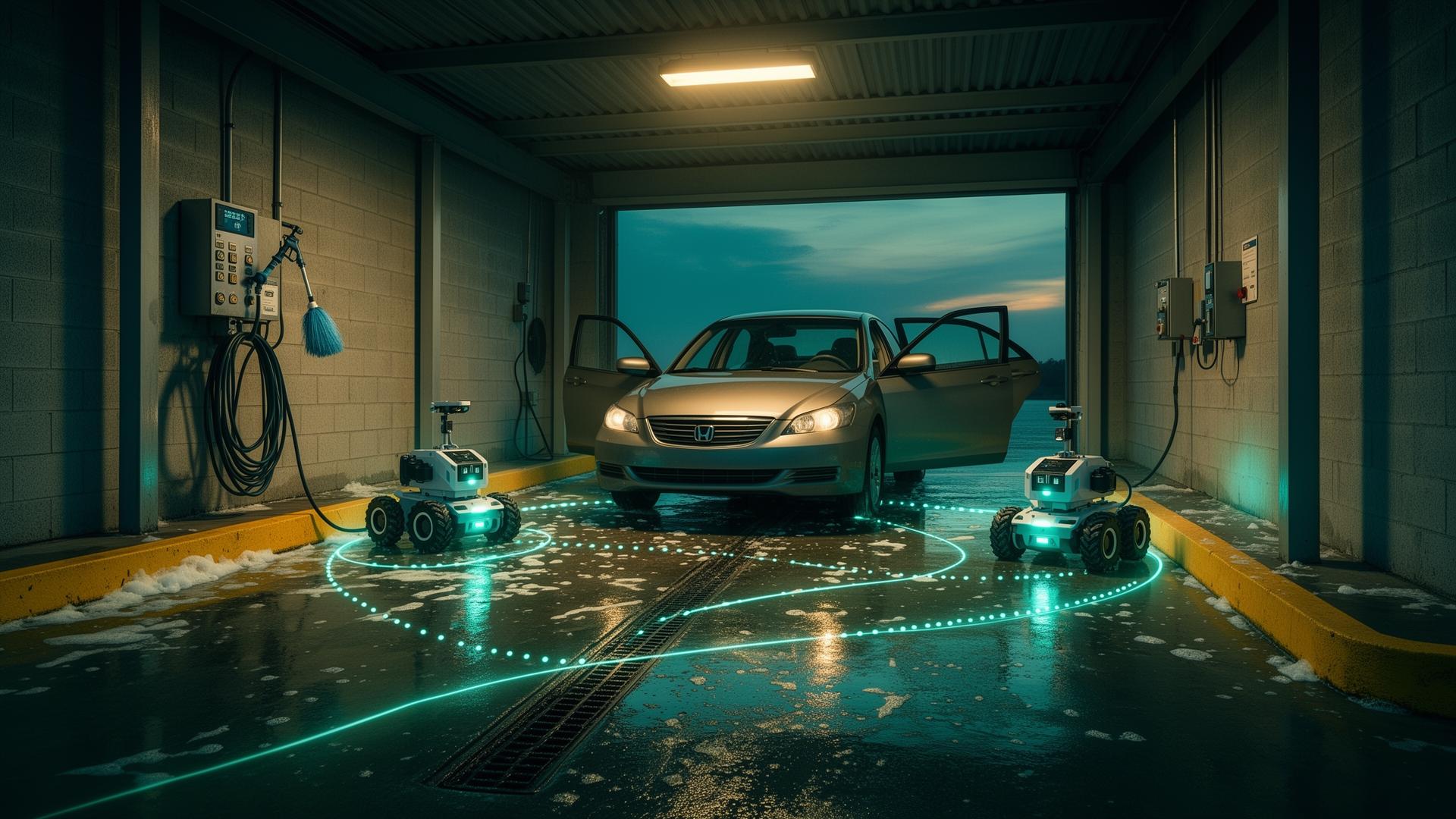
This Is an Outside-the-Car Navigation Problem
The first thing to make explicit is the scope: the robot is never inside the cabin. It operates in the car-cleaning environment, moves between vehicles, approaches different open doors from outside, positions the arm at the sill, completes the task, retracts, and then navigates to the next access point. The design question is therefore not 'what base works inside a vehicle' but 'what base works best in the navigation envelope around vehicles being cleaned.'
That envelope is awkward. In many wash centers, detail stalls, fleet prep lanes, and hand-cleaning operations, the usable side aisle beside a parked vehicle is only 0.9-1.4 m once doors, hoses, bins, floor drains, and nearby vehicles are accounted for. The robot also has to reason around open-door swing arcs, which project well into the lane and create moving geometric constraints that are more important than the nominal bay width in a floor plan.
So the real mobility requirement is a sequence of repeated external docking moves: approach one open door, align to it, hold position, retreat, translate to the next door, and do that again without demanding that operators constantly reposition the vehicle. Once you frame the task that way, the drive geometry discussion becomes much cleaner: every kinematic choice is really a decision about turning radius, swept envelope, lateral repositioning, traction on contaminated floors, and lifetime cost.
Ackermann: Efficient in Open Space, Expensive in Tight Cleaning Geometry
Ackermann steering is the natural starting point because it is familiar, dynamically stable, and mechanically efficient. If a robot has to drive long distances through open aisles or outdoor transfer lanes, a car-like base makes immediate sense. It tracks well, handles uneven transitions cleanly, and usually has the lowest control burden at speed.
But the same geometry becomes a handicap when the task is repeated docking beside different open doors in a constrained cleaning site. Ackermann steering imposes a hard minimum turning radius. That means the robot cannot simply slide from one docking pose to the next; it has to execute arc-based maneuvers and, in many real lanes, multi-step reversals. In a wash or detail environment this creates lost time, more planner complexity, and higher collision risk near open doors and adjacent vehicles.
The cost story is subtle. Ackermann often looks cheap at the actuator level, but it can become operationally expensive because the site has to tolerate its turning envelope. If the lane is tight, you pay either in lost throughput, more complicated approach planning, or layout concessions. In other words, Ackermann does not necessarily cost more in hardware, but it may cost more in the geometry of the operation.
Ackermann steering: front wheels share an instantaneous center of rotation (ICR) far to the side, producing a wide minimum-radius arc that collides with open-door swing zones in tight cleaning lanes.
Differential Drive Is Not One Thing: Rear, Front, and Mid Layouts Behave Differently
Differential drive is often treated as the default answer for service robots because it is inexpensive, robust, and easy to control. That is broadly true. Two driven wheels and passive support wheels give you in-place rotation, a modest parts count, and predictable low-speed behavior. For many cleaning operations, that already makes differential drive much more suitable than Ackermann.
The mistake is treating all differential layouts as equivalent. The moment the robot has to align with door openings while carrying an arm, the location of the drive axle matters. Rear-wheel differential tends to make the front of the robot sweep a larger arc during heading changes. Front-wheel differential reduces swing near the front tool area but increases tail sweep behind the chassis. Mid-wheel differential centers the pivot and usually minimizes the swept circle, which is exactly why wheelchair designers favor it in narrow human environments.
From a cost and navigation standpoint, differential layouts are often the best compromise when true lateral motion is not essential. They are cheaper than swerve, less maintenance-intensive than mecanum, and much easier to keep controllable on dirty or wet concrete. But they remain non-holonomic: moving from one open door to the next still requires turn-translate-turn behavior. In sites where that pattern is repeated all day, the time penalty becomes meaningful.
Differential layouts compared. The pivot sits on the drive axle; everything in front of and behind it sweeps a circle. Mid-axle drive minimises the swept envelope — the same reason mid-wheel powered wheelchairs dominate narrow human spaces.
Holonomic Drives: You Pay for Sideways Motion, Then Pay Again for Surface Reality
Holonomic drives become attractive the moment the workflow demands repeated sideways repositioning along a vehicle body. If the robot can keep its tool orientation fixed and simply translate to the next door, the approach sequence is shorter, easier to plan, and usually safer around open doors. That is the strongest argument for holonomy in car-cleaning environments.
But 'holonomic' bundles together very different engineering realities. Mecanum is the lower-cost route to sideways motion, yet it is also the most sensitive to water, soap film, grit, and debris. Omni-wheel layouts are similarly sensitive and are usually less attractive for heavier cleaning robots that need payload, arm stiffness, and repeatable contact positioning. Swerve is the most capable because it preserves conventional tire contact while still enabling arbitrary planar motion, but it is mechanically and financially much more expensive.
That cost is not just BOM. Holonomic systems can impose more on controls, calibration, spare parts, and field service. A swerve base may be the technically best answer in a wet, high-throughput interior-cleaning line, but it only stays the best if the operation can absorb module complexity, steering encoders, maintenance procedures, and downtime risk. So the right question is not simply whether holonomy is useful; it is whether the productivity gain from better navigation outweighs the capital and service burden of the drive system.
Holonomic wheel families. Mecanum uses 45° angled rollers; omni uses perpendicular rollers; swerve steers each conventional wheel independently. All three permit pure sideways translation — the kinematic property that lets the robot slide between open doors without re-orienting.
Which Drive Type Fits Which Cleaning Environment
In dry detail centers with reasonably flat floors and disciplined housekeeping, the design choice comes down to throughput versus spend. If the lanes are not extremely tight, a mid-wheel differential base is often the best value because it minimizes swept circle without introducing holonomic maintenance burden. If the workflow requires high-frequency repositioning between front and rear doors on every vehicle, mecanum can be justified, but only if the floor stays clean enough to preserve traction and odometry quality.
In wet wash centers and mixed cleaning operations where the robot sees standing water, grit, drain slopes, and hose clutter, the environment becomes hostile to roller-based holonomic drives. That usually pushes the shortlist toward mid-wheel differential for minimum-cost robustness or swerve for maximum maneuverability with conventional tire contact. Ackermann is usually the least compatible because the aisle geometry punishes its turning radius.
In other cleaning-operation environments such as fleet prep depots, rental return lanes, service garages, and staging corridors where the robot has longer transits between tasks, the answer depends on how often it must dock beside multiple doors per vehicle. If the robot mostly travels and occasionally docks, differential can win. If the robot repeatedly works multiple door positions in tightly parked rows, holonomic motion becomes much more valuable. The compatibility question is therefore straightforward: the tighter the lane and the more often the robot must shift sideways between open-door positions, the more the environment favors holonomic drive; the dirtier and wetter the floor, the more it favors conventional traction wheels and penalizes roller-based systems.
Compatibility map across cleaning environments. Read by row: each drive family is rated for tight-lane maneuvering, wet/contaminated floor performance, capital cost, and field maintenance burden.
Door Openings, Vacuum Bays, and the Real Aisle Budget
Before picking a drive type, you need the actual numbers the site imposes on you. The dominant constraints in a car-cleaning environment are vehicle width, open-door swing, adjacent-vehicle spacing, and vacuum-bay stall width. Each of these varies by vehicle class, and the robot has to fit the worst case it will see in the operation, not the average.
Typical body widths (mirrors folded): a compact sedan is ≈ 1.78 m, a mid-size SUV ≈ 1.95 m, and a full-size pickup truck ≈ 2.05-2.10 m. Front-door open swing measured perpendicular to the body is roughly 0.95-1.05 m for sedans, 1.05-1.15 m for SUVs, and 1.10-1.25 m for full-size trucks (longer doors, wider opening angle for cabin access). Rear doors are slightly shorter but live closer to the rear wheel, where hose carts and vacuum heads tend to clutter the floor.
Vacuum-bay stall widths in self-serve and detail layouts cluster around three values: 3.5 m (compact stall, common in older sites), 3.8-4.0 m (industry standard for most new builds), and 4.5 m (premium / SUV-friendly stalls). Subtract the vehicle and one open door and you are left with a working aisle of roughly: sedan in a 3.8 m bay → ~1.0 m; SUV in a 3.8 m bay → ~0.75 m; truck in a 3.8 m bay → ~0.55 m. That last number is below the chassis width of most service robots — which means in a standard bay, a truck with a fully-open door leaves no room for the robot to pass alongside it. The robot has to either approach from the open side only, or wait for the door to close between docks.
- L × W
- 4880 × 1840 mm
- Wheelbase
- 2825 mm
- Front / Rear door
- 1050 / 980 mm
- B-pillar gap
- 120 mm
- Open angle θ
- 70°
- Door lateral proj.
- 987 mm
- Residual aisle
- 773 mm
- L × W
- 4600 × 1855 mm
- Wheelbase
- 2690 mm
- Front / Rear door
- 1080 / 1020 mm
- B-pillar gap
- 140 mm
- Open angle θ
- 70°
- Door lateral proj.
- 1015 mm
- Residual aisle
- 730 mm
- L × W
- 5890 × 2030 mm
- Wheelbase
- 3680 mm
- Front / Rear door
- 1140 / 1100 mm
- B-pillar gap
- 150 mm
- Open angle θ
- 65°
- Door lateral proj.
- 1033 mm
- Residual aisle
- 537 mm
Plan view of a 3.8 m vacuum bay with sedan, SUV, and truck overlays. The shaded zone is the residual working aisle once the vehicle and one open door are accounted for. The robot's swept envelope must fit inside that residual.
Right-Size the Chassis, Then Pick the Drive
Combining the kinematic budgets from sections 02-05 with the bay budgets from section 06 collapses the design space to a small number of viable combinations. The chassis must satisfy two independent inequalities: chassis width ≤ residual aisle in the worst-case stall, and swept rotation radius ≤ half of the longest open clearance. The first sets a hard upper bound on width; the second decides whether you need holonomic motion at all.
For sedan-dominant operations (rideshare prep, compact-fleet detail), a 0.45-0.55 m wide chassis with mid-wheel differential drive is the cost-optimal answer. The 475 mm swept circle fits inside a 1.0 m residual aisle with margin, and the two-motor drivetrain keeps capital and service cost minimum. Ackermann is rarely justified here; the radius is too large for repeated multi-door docking.
For mixed sedan/SUV fleets in standard 3.8 m bays, the residual aisle drops to ≈ 0.75 m and the robot must still rotate beside an open door. A 0.50-0.55 m chassis with mid-wheel differential still works, but the planner has to time door openings. If the operation cannot tolerate that timing constraint, mecanum or omni at the same footprint buys door-to-door translation without rotating — and the cost premium (≈ 1.8-2.2×) is usually justified by the throughput recovery.
For truck-heavy operations (rental-fleet pickups, work-vehicle prep) or premium SUV bays, the residual aisle in a standard stall is below the chassis width with the door open. The viable solutions are: (a) upgrade the site to 4.5 m stalls and use mid-wheel differential, (b) enforce single-side approach and accept the throughput hit, or (c) deploy swerve on a narrower 0.45 m chassis to enable strafing through the gap with no rotation. Swerve's ≈ 4.5× drivetrain cost is the price you pay for not changing the building.
Decision matrix: vehicle mix × bay width → recommended chassis width and drive type. Green cells indicate combinations that satisfy both the aisle-fit and rotation-clearance inequalities; amber requires planner-side timing; red requires either site upgrade or swerve.
Use the site geometry first, then pick the base architecture second.
Visit handybot.ai →From DFM to DFMA to Design for Automated Assembly — and now to systems designed around perception, adaptation, and learning. Why the next generation of factories will be optimized for variation, not repetition.