The Gripper Is the Robot
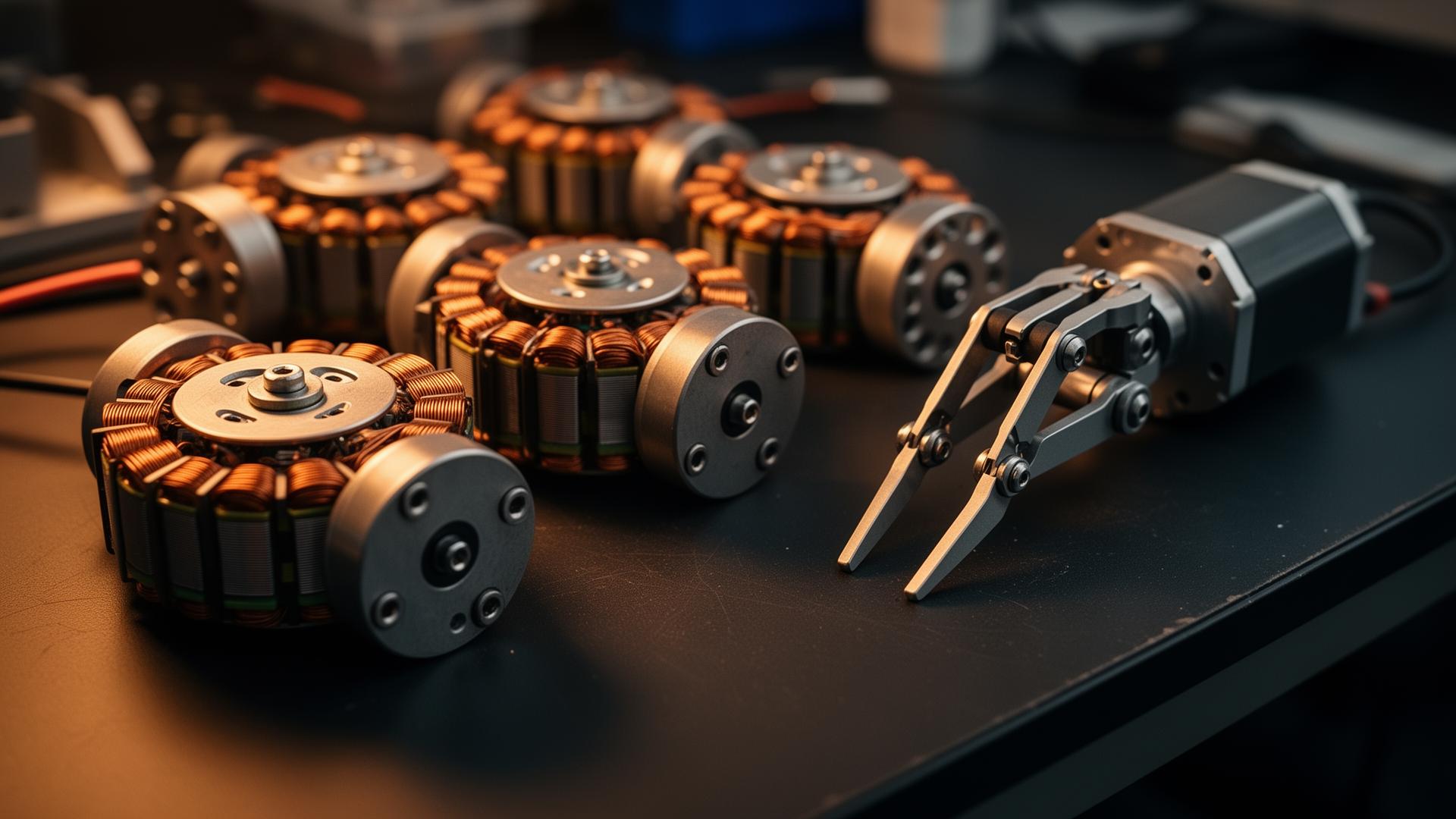
An industrial arm without an end effector is a very expensive paperweight. The gripper is where kinematics meets the world — where torque, position, and planning translate into a successful (or failed) grasp. Yet end effectors are routinely the last component specified, and the first to limit the system's real-world performance.
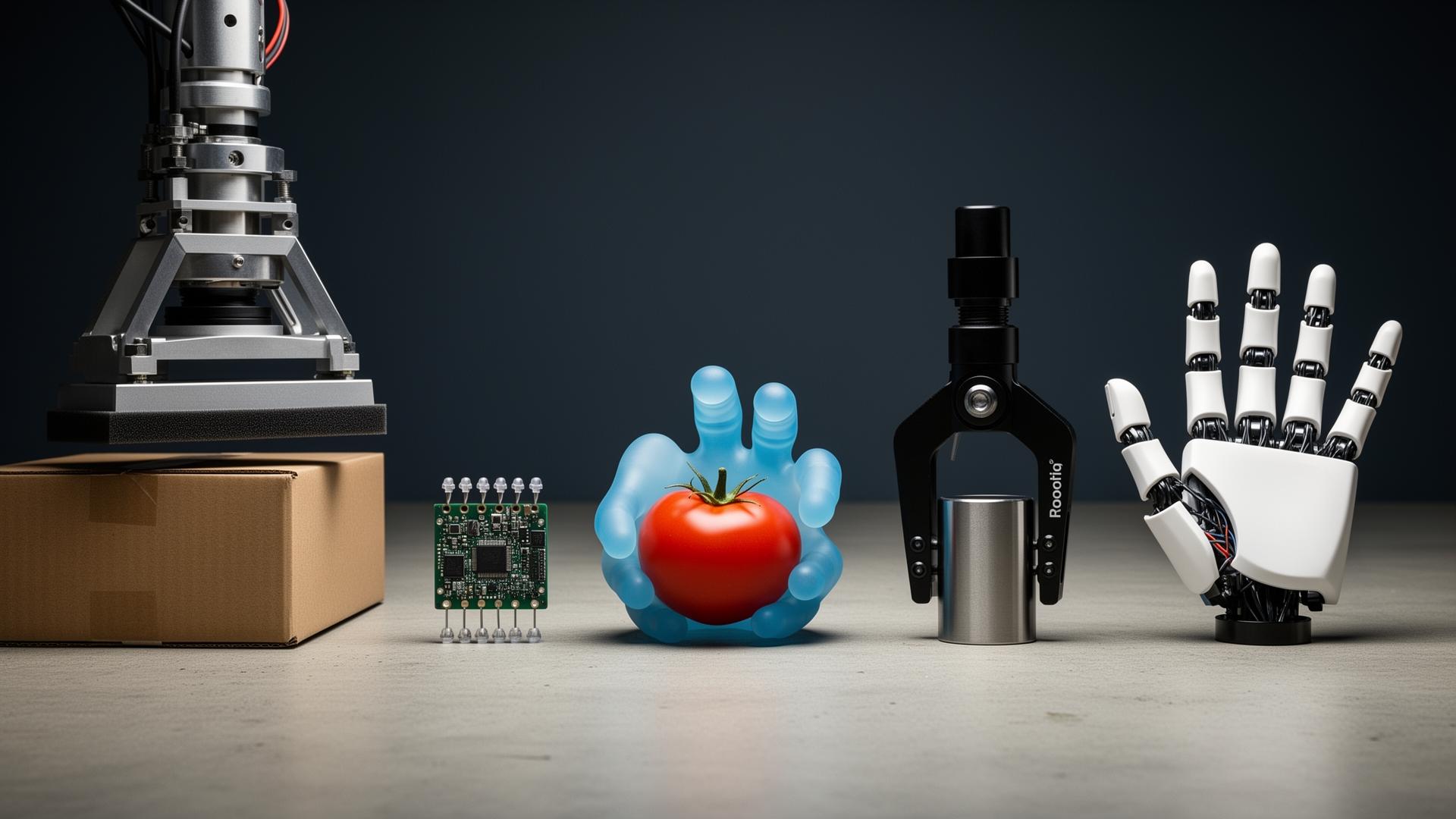
Three properties dominate any honest gripper trade study:
Dexterity — the breadth of object geometries, materials, and grasp poses the gripper can handle without retooling. A vacuum cup is brilliant on flat cardboard and helpless on a perforated lattice. A five-fingered hand can theoretically grasp anything a human can, but at vastly higher cost and control complexity.
Efficiency — cycle time, energy per pick, and the compute load placed on the controller. Efficiency is where vacuum and parallel-jaw grippers crush more sophisticated alternatives in high-volume environments.
Effectiveness — first-pick success rate on the actual SKU mix, integrated over realistic variation in pose, lighting, and product condition. This is the metric that determines whether the cell ever leaves a pilot.
This guide walks the five gripper families that cover the overwhelming majority of real deployments — vacuum, micro-vacuum, soft, two-finger, and full-hand — with vendor-verified specifications and peer-reviewed references at the end.
Vacuum Grippers: The Workhorse of Pick & Place
Vacuum gripping is the dominant end-effector technology in logistics, packaging, and depalletization. A vacuum generator (venturi or electric pump) evacuates air from one or more suction cups in contact with a workpiece; atmospheric pressure on the back side of the part holds it against the cup until the vacuum is released or broken.
Design principle: Holding force scales linearly with the projected sealed area and the achieved vacuum level. A 50 mm circular cup at −60 kPa generates roughly 118 N of theoretical vertical pull-off force; rules of thumb from Schmalz and Piab application guides recommend designing to 1.5–4× the part weight depending on acceleration and orientation.
Cup selection matters more than the pump. Bellows cups deflect to compensate for surface angle and height variation, ideal for poly-bagged or curved goods. Flat cups give the highest holding force per area on rigid, flat substrates. Foam end-effectors and area gripping systems (e.g. Schmalz FQE/FXP) seal across irregular footprints by sacrificing per-port pressure for coverage — the right choice for mixed-SKU palletizing.
Where vacuum wins: flat or convex rigid surfaces, glossy boxes, glass, sheet metal, and polybagged goods. Where it fails: porous textiles, perforated metal, deeply textured surfaces, and any object the cup cannot fully seal against. Wet, dusty, or oily contact surfaces also degrade seal life rapidly.
Sectional view of a bellows-style vacuum cup sealed against a rigid workpiece. Holding force scales as ΔP × projected sealed area; design margin of 1.5–4× part weight per Schmalz / Piab application guidance.
Micro Vacuum Grippers: SMD, Wafer & MEMS Handling
At the small end of the vacuum spectrum, the same physics scales down to handle individual surface-mount components, semiconductor dies, and micro-optics. Cup diameters fall to 0.3–3 mm and the entire gripper often weighs less than a gram so it can ride a high-speed pick-and-place head.
Design principle: Below ~5 mm cup diameter, two effects begin to dominate. First, the achievable holding force becomes very small (a 1 mm cup at −80 kPa gives roughly 0.06 N), so part mass and inertia must stay correspondingly low. Second, electrostatic and Van der Waals adhesion between the part and the cup compete with the vacuum release — many micro-pickers add a positive 'blow-off' pulse to actively eject parts.
ESD safety is mandatory for electronics handling. Conductive silicone or carbon-loaded polymer cups dissipate static through the gripper body to ground, preventing latent CMOS damage. Vendors like Zephyrtronics, SMC, and Schmalz publish dedicated ESD-safe cup lines.
At the extreme, silicon micromachined microgrippers (e.g. Zyvex NanoEffector) move from suction to compliant mechanical jaws actuated by thermal or electrostatic effects, handling features in the 1–500 µm range. These are research and semiconductor-fab tools rather than general automation parts, but they bound the lower limit of what a 'gripper' can mean.
ESD-safe sub-millimetre nozzle picking a 0402 SMD. At this scale Van der Waals and electrostatic adhesion rival the vacuum, so the cycle ends with a positive blow-off pulse to actively eject the part.
Soft Pneumatic Grippers: Compliance for Delicate Goods
Soft grippers replace rigid jaws with elastomeric fingers — typically silicone PneuNet structures or fiber-reinforced bending actuators — that conform to the object on contact rather than fighting against geometric uncertainty. The seminal commercial example is Soft Robotics Inc. (acquired by ABB in 2023), whose cup-style actuators became standard equipment on poultry, produce, and bakery lines.
Design principle: A silicone body with sequential internal chambers is bonded to an inextensible strain-limiting layer. Pressurization expands the chambers asymmetrically; the body curls toward the limiter and wraps the part. Pressure regulation — not position control — sets the grasp force, which inherently limits damage on irregular or fragile items.
Festo's DHEF adaptive shape gripper takes a different soft approach: a silicone bellows ring that everts inside-out around an object, behaving like a fishing-net 'finger trap'. It excels at mixed-shape picking from totes when accurate object pose is unavailable.
Where soft grippers win: food, produce, cosmetics, e-commerce mixed SKUs, biological tissue handling, anything that bruises. Where they struggle: high-precision placement (the compliance that makes them safe also makes the final pose stochastic), heavy payloads, and high cycle-rate environments where the elastomer fatigue life becomes the bottleneck.
Recent reviews (Frontiers in Materials, 2025) document over a decade of academic exploration into dielectric-elastomer, jamming, and electroadhesive variants — but pneumatic PneuNets remain the dominant production form factor.
PneuNet finger in two states. Pressurising the sequential chambers expands the convex (outer) face while the inextensible strain-limiter on the concave (inner) face stays fixed in length — the asymmetry curls the finger around the part.
Two-Finger Parallel & Adaptive Grippers
If vacuum dominates logistics, the parallel-jaw gripper dominates collaborative robot cells. Two opposed fingers translate symmetrically along a guide; the finger geometry and tip material are application-specific, the actuation is electric, pneumatic, or hydraulic, and the controller exposes position, force, and gap as first-class commands.
Robotiq 2F-85 is the canonical reference for cobot integration. The published datasheet specifies 85 mm stroke, 5–235 N adjustable grip force, ~2.5 kg form-fit payload, ~5 kg friction-grip payload, and a built-in encompassing-grasp mode where the underactuated linkage curls the fingertips around the object after first contact. The 2F-140 variant trades force for a 140 mm stroke.
Schunk PGN-plus and the broader EGK / EGI electric series target industrial cells with higher cycle rates, IP-rated sealing, and integrated absolute encoders. Pneumatic incumbents (SMC MHZ2, Festo DHPS) remain unbeaten on cost-per-cycle for fixed-stroke binary grasps in mass production.
Adaptive (underactuated) grippers like the Robotiq 3-Finger and Schunk SDH bridge to dexterous hands by adding a third opposable finger and tendon-driven joint coupling. They handle a much wider object set than a parallel jaw without the cost or control burden of a fully articulated hand — an attractive sweet spot for research and unstructured pick-and-place.
Where two-finger grippers win: machine tending, assembly, kitting, and any task where the part can be approached along a known axis with a rigid pinch. Where they struggle: thin sheets lying flat (no purchase), highly compliant objects (deformation under pinch), and tasks needing in-hand manipulation.
Symmetric parallel-jaw kinematics with the published Robotiq 2F-85 spec card. The encompassing-grasp inset shows the underactuated linkage curling the fingertips around the part after first contact.
Full-Hand Anthropomorphic Grippers
Five-fingered, multi-DoF robotic hands sit at the dexterity ceiling. They exist because human tools, controls, doorknobs, and workpieces are designed for human hands — and any humanoid that wants to operate in human environments without bespoke fixturing eventually needs comparable end effectors.
Shadow Dexterous Hand (Shadow Robot Company) remains the long-standing research benchmark: 24 joints, 20 actuated DoF, tendon drive from a forearm pack, position and force sensing on every joint, and tactile arrays on the fingertips. Its newer DEX-EE series, co-developed with Google DeepMind, prioritizes robustness for reinforcement-learning workloads where the hand will be intentionally driven into singularities and contacts during training.
Allegro Hand (Wonik Robotics) is the affordable workhorse of academic dexterous-manipulation research: 4 fingers, 16 independent torque-controlled joints, ROS-native, and routinely used as the platform for grasp-policy and tactile-learning papers. It sacrifices the Shadow Hand's full thumb opposition envelope for a much lower price point.
Humanoid-class hands from Tesla (Optimus), Figure, 1X, Sanctuary AI, and others are converging on roughly 11–22 actuated DoF with tendon or linkage drives, integrated tactile sensing, and onboard motor drivers. Specs are largely vendor-announced rather than independently verified at this stage and should be read accordingly.
Where full hands win: teleoperation, dexterous research, humanoids interacting with human-scale environments, any task requiring in-hand reorientation or tool use. Where they struggle: cost (often 10–100× a parallel jaw), control complexity (high-dimensional contact-rich planning is still an open research area), maintenance (tendons stretch and break), and cycle-time-sensitive industrial work where simpler grippers are unbeatable.
Joint topology of a Shadow-class dexterous hand: 24 actuated DoF (4 fingers × 4 DoF, 5-DoF thumb, 2-DoF wrist, 1-DoF palm arch), tendon-routed to a forearm-mounted actuator pack with per-joint position and force sensing.
Dexterity vs. Efficiency vs. Effectiveness
There is no universal 'best' gripper — only a best gripper for a defined SKU set, cycle time, and budget. The honest selection sequence:
1. Characterize the SKU envelope first, the gripper second. Measure the smallest and largest part, the heaviest mass, the most fragile failure mode, and the worst-case surface (perforated? textured? wet?). Most failed deployments choose a gripper before doing this work.
2. Default to the simplest gripper that covers the envelope. Vacuum if the SKUs are predominantly flat/rigid and sealable. Two-finger if approach axes are predictable and parts are rigid. Soft if the SKU set includes irregular, fragile, or compliant items. Full-hand only if the task actually requires in-hand manipulation or tool use — almost always a research, teleop, or humanoid context.
3. Multi-tool, not super-tool. Modern cobot cells increasingly use a tool changer (e.g. ATI QC-11, Schunk SWS) with two or three specialized end effectors instead of one universal gripper. The cycle-time cost of a tool change is usually less than the effectiveness cost of forcing a single gripper to handle every SKU.
4. Budget for sensing. A gripper without force or tactile feedback is operating open-loop on the most uncertain part of the system. For anything beyond rigid-part pick-and-place, integrated force sensing (parallel jaws) or tactile arrays (soft and dexterous hands) is what converts a clever mechanism into a reliable one.
At Handybot, we landed on a soft-pneumatic primary tool with a force-controlled tool changer because cabin detailing spans rigid debris, fabric, paper trash, and wet wipes — no single rigid gripper covers the SKU envelope, and the cost of an in-cabin scratch is far higher than the cost of compliance.
The Essence — Why Engineers Pick Three Fingers Over Five
If you read nothing else from this guide, internalize the lessons below. They reframe the gripper as a system decision, not a part on a BOM — and they explain why production robotics has quietly converged on the three-finger gripper as the optimization sweet spot, even though biology gave us five.
The Cutkosky taxonomy sets the bar, not the target. Mark Cutkosky's 1989 grasp taxonomy [11] catalogued the human hand's repertoire — power wraps, precision pinches, lateral keys, spherical cages, hooks — and it remains the gold standard every robotics engineer measures against. But the taxonomy describes what a biological end effector can do, not what an engineered one should. Copying biology directly (full biomimicry) is rarely the optimal answer outside humanoid research; the right move is to pick the smallest mechanism that covers your SKU envelope.
1. The gripper bounds the robot. Reach, payload, and repeatability are arm specs; what the cell can actually do is set by the end effector. A 0.02 mm-repeatable arm with the wrong gripper is a 50 mm-repeatable system. Specify the gripper against the SKU envelope before you specify the arm.
2. Physics is the cheapest controller. Vacuum exploits atmospheric pressure. Soft pneumatics exploits asymmetric strain. Underactuated parallel jaws exploit linkage compliance to wrap an unknown shape. Every gripper family that scales in production substitutes a passive physical principle for an expensive active control loop. When you find yourself adding sensors and software to compensate for the wrong mechanism, change the mechanism.
3. Form closure beats force closure — and three contacts is the magic number. A 2-finger gripper holds objects through force closure: friction at the contact patches resists slip, which makes it cheap and durable but unreliable on smooth, wet, or irregular geometries. A 3-finger gripper achieves form closure: three non-collinear contact points are mathematically sufficient to fully constrain a rigid object in the plane (and with a wrist, in 3D for a wide class of shapes). The geometry self-centers spheres, cylinders, and prisms with no active control. This is why the Robotiq 3F, Schunk SDH, and Barrett Hand exist — and why they keep showing up on production cells where 2F grippers can't hold their success rate.
4. Five fingers buys in-hand manipulation, and you usually don't need it. A 5-finger dexterous hand (Shadow, Allegro, DEX-EE) can rotate, shift, and reposition an object without releasing it — the regrasp capability that makes humans extraordinary tool users. The cost: 16–24+ actuated joints, fragile tendon or cable systems, demanding tactile feedback, and AI control stacks that are still active research areas. Unless your robot must hold scissors, manipulate paper, fold cloth, or operate human tools designed for five fingers, the 5F hand pays a steep complexity tax for capability the application doesn't monetize.
5. Effectiveness is the only metric that ships. Dexterity sells demos, efficiency sells spec sheets, but first-pick success rate on the actual SKU mix — measured under realistic pose, lighting, and product variation — is what determines whether a cell graduates from pilot to line. The 3F gripper wins not because it's the most capable, but because it's the highest effectiveness per dollar per joint across the broadest SKU envelope.
6. Multi-tool beats super-tool. A tool changer with two or three specialized heads almost always outperforms a single 'universal' gripper on a heterogeneous line. The cycle-time tax of a swap is reliably smaller than the effectiveness tax of forcing one mechanism to cover an envelope it was never designed for. A 2F gripper plus a vacuum cup, swapped automatically, will beat a 5F hand on cost, uptime, and pick rate for 90% of warehouse and packaging work.
7. Sensing is not optional past pick-and-place. A gripper without force or tactile feedback is open-loop on the most uncertain interface in the system: the contact patch. Integrated force sensing on parallel jaws and tactile arrays on soft/dexterous hands are what convert a clever mechanism into a reliable one — budget for them from day one, not as a v2 upgrade.
The bottom line. Humans have five fingers because evolution didn't optimize — it accumulated. Engineers have the luxury of choosing, and the choice that keeps winning in industry is three. As Hoang Thanh (LeonLegion) puts it in a sharp recent practitioner write-up [12]: "Humans use five fingers because nature gifted them to us, but engineers choose three because it represents the pinnacle of optimization." Pick the dexterity floor your task actually requires, then stop.
Verified Sources & Further Reading
Every numerical claim and product reference in this guide is drawn from one of the citations below. Vendor datasheets (Robotiq, Shadow, Wonik, Schmalz, Festo) supply published spec values; peer-reviewed reviews supply the broader landscape claims. Where a number is vendor-reported rather than independently verified, the prose says so explicitly.
Comparative research literature. Beyond datasheets, the citations below now include the canonical comparative surveys and benchmark papers from the prestigious robotics venues — IEEE Transactions on Robotics (T-RO), the International Journal of Robotics Research (IJRR), Science Robotics, Soft Robotics, Annual Review of Control, Robotics, and Autonomous Systems, and the proceedings of ICRA, IROS, and RSS. References [13]–[20] cover grasp taxonomies and analysis (Bicchi & Kumar, Feix et al.), soft gripper reviews (Shintake et al., Hughes et al.), underactuated and adaptive hand design (Dollar & Howe's SDM Hand, Odhner et al.'s iHY/Yale-OpenHand), data-driven grasping benchmarks (Mahler et al., Dex-Net), and the most-cited recent reviews on robotic end-effectors and manipulation. They are the right starting point if you want to go from this guide into the primary literature.
- [01]Robotiq 2F-85 & 2F-140 Adaptive Gripper — Instruction Manual (e-Series)Robotiq Inc. · Robotiq 2F-85 / 2F-140
- [02]Shadow Dexterous Hand — Technical Specification (June 2024)Shadow Robot Company · Shadow Dexterous Hand
- [03]DEX-EE Series Robot Hand (Shadow Robot × Google DeepMind)Shadow Robot Company · DEX-EE Series
- [04]Allegro Hand — Wonik Robotics product page (4 fingers, 16 torque-controlled joints)Wonik Robotics · Allegro Hand
- [05]Area Gripping Systems and End Effectors (FQE, FXP, SLG)J. Schmalz GmbH · Schmalz Area Gripping
- [06]Festo DHEF-20-A Adaptive Shape Gripper — product datasheetFesto / Motion World · Festo DHEF
- [07]mGrip modular gripper — Soft Robotics Inc. (now part of ABB)The Robot Report · Soft Robotics mGrip
- [08]Soft robotic grippers: a review (Frontiers in Materials, Oct 2025)Frontiers in Materials · Soft Grippers Review
- [09]Design of a Multi-Mode Hybrid Micro-Gripper for SMT Component AssemblyMicromachines (MDPI), 2023 · Hybrid Micro-Gripper
- [10]Zyvex NanoEffector Microgrippers — micromachined silicon end-effectors (1–500 µm features)Zyvex Labs · Zyvex NanoEffector
- [11]SMD Vacuum Lifting & Small Parts Pick-and-Place — ESD-safe suction systemsZephyrtronics · Zephyrtronics ESD
- [12]Cutkosky, M.R. — On grasp choice, grasp models, and the design of hands for manufacturing tasks (IEEE T-RA, 1989)IEEE Transactions on Robotics and Automation · Cutkosky Grasp Taxonomy
- [13]Hoang Thanh (LeonLegion) — "The Gripper Design Problem: When Are 3 Fingers Better Than 5?" (LinkedIn, 2024)LinkedIn — Hoang Thanh / LeonLegion · Practitioner Perspective
- [14]Bicchi, A. & Kumar, V. — "Robotic grasping and contact: a review" (ICRA 2000)Proc. IEEE ICRA 2000 · Bicchi & Kumar — Robotic Grasping
- [15]Feix, T., Romero, J., Schmiedmayer, H.-B., Dollar, A.M., Kragic, D. — "The GRASP Taxonomy of Human Grasp Types" (IEEE T-HMS, 2016)IEEE Transactions on Human-Machine Systems · Feix et al. — GRASP Taxonomy
- [16]Dollar, A.M. & Howe, R.D. — "The Highly Adaptive SDM Hand: Design and Performance Evaluation" (IJRR, 2010)International Journal of Robotics Research · Dollar & Howe — SDM Hand
- [17]Odhner, L.U. et al. — "A compliant, underactuated hand for robust manipulation" (IJRR, 2014)International Journal of Robotics Research · Odhner et al. — iHY / Yale-OpenHand
- [18]Shintake, J., Cacucciolo, V., Floreano, D., Shea, H. — "Soft Robotic Grippers" (Advanced Materials, 2018)Advanced Materials (Wiley) · Shintake et al. — Soft Grippers Review
- [19]Hughes, J., Culha, U., Giardina, F., Guenther, F., Rosendo, A., Iida, F. — "Soft Manipulators and Grippers: A Review" (Frontiers in Robotics and AI, 2016)Frontiers in Robotics and AI · Hughes et al. — Soft Manipulators & Grippers
- [20]Mahler, J. et al. — "Dex-Net 2.0: Deep Learning to Plan Robust Grasps with Synthetic Point Clouds and Analytic Grasp Metrics" (RSS 2017)Proc. Robotics: Science and Systems (RSS) 2017 · Mahler et al. — Dex-Net 2.0
- [21]Billard, A. & Kragic, D. — "Trends and challenges in robot manipulation" (Science, 2019)Science (AAAS) · Billard & Kragic — Manipulation Review
- [22]Yang, G.-Z. et al. — "The grand challenges of Science Robotics" (Science Robotics, 2018) — manipulation & end-effector challengesScience Robotics (AAAS) · Yang et al. — Grand Challenges of Science Robotics
Talk to us about gripper selection for your line
Visit handybot.ai →Inside the four-input policy we are building. Why audio cues matter for distinguishing sand from glass shards, and what the architecture looks like before the data is in.