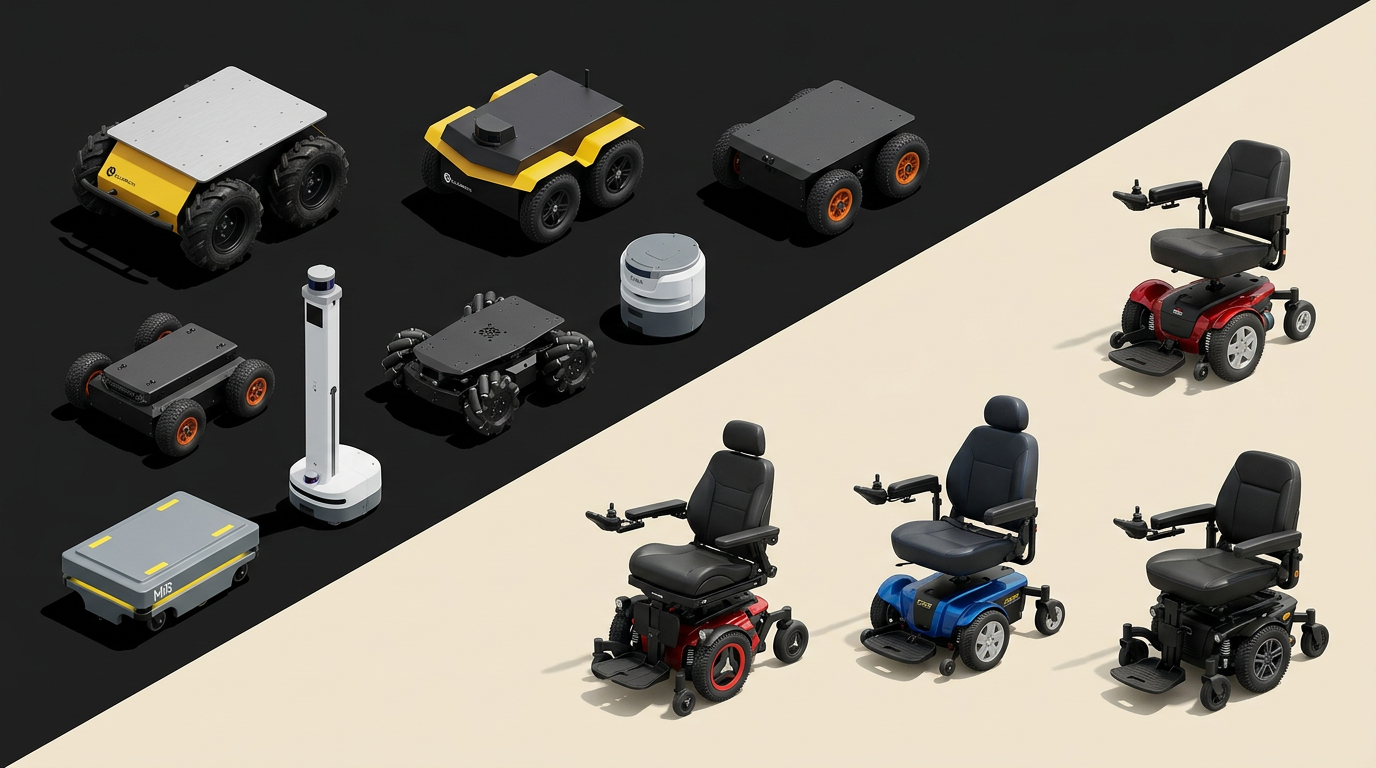
The Mobile Base Market Is Small, Specialized, and Priced Like It
Before talking about specific platforms, it helps to be honest about the market. Worldwide, the research-grade mobile base segment — Clearpath, AgileX, Boston Dynamics' Spot if you stretch the definition, Hello Robot, Fetch (now Zebra), MiR, Neobotix, Robotnik, Intermode — sells in the low tens of thousands of units per year combined. The powered wheelchair industry, for comparison, ships roughly 350-450k units per year in the US alone through Permobil, Pride/Quantum, Sunrise/Quickie, Invacare, and dozens of regional makers.
That volume gap shows up directly in price-per-kilogram-of-drivable-mass. A Clearpath Husky lists for around $27-30k in a base configuration; an AgileX Scout Mini sits near $8-9k; a Hello Robot Stretch 3 is $24,950 (admittedly that includes the arm). A mid-range Quantum Q6 Edge powered wheelchair — which carries 130 kg of human, climbs curbs, runs all day, and survives years of outdoor abuse — sells for $5-8k. The hardware inside isn't fundamentally different. The economics are.
If you're building a robot for a real commercial application, this matters. The mobile base is rarely the value-add of your product — your value is in the arm, the perception stack, the application software, the workflow integration. Spending $25k on a chassis whose dominant cost driver is low-volume manufacturing and research-customer margin is a defensible choice when you're prototyping, but it can become a barrier when you try to ship at unit-economic-positive scale.
Anatomy of a Mobile Base: What's Actually in That Sticker Price
When you write a $25k purchase order for a research-grade mobile base, you are paying for a fairly predictable BOM stack. The drivetrain (motors, controllers, gearboxes, encoders) is typically 20-30% of cost. The battery pack (sealed Li-ion with BMS, often custom form factor) is another 10-15%. Compute and sensor harness (an industrial PC or NVIDIA module, IMU, sometimes a base lidar) account for 12-20%. The chassis, wheels, and weatherproofing are 15-25%. The remainder — often 25-35% — is integration, testing, documentation, support, ROS driver maintenance, and margin.
That last bucket is where the industry's economics live. Clearpath, AgileX, and the rest sell into research labs, defense primes, and pre-production engineering teams that need a working ROS-compatible platform tomorrow. They're not selling sheet metal; they're selling the engineer-hours that would otherwise be spent integrating a Roboteq controller with a custom battery and writing a `nav2`-compatible driver. For a research customer, that's an honest trade. For a startup chasing unit economics, it's a tax you pay every time you build another robot.
The other thing you're buying — and this matters — is mechanical and electrical reliability under abusive use. A Husky will survive being driven into curbs by a graduate student. A Stretch will tolerate being hot-swapped between labs. The build quality is genuinely high, the documentation is genuinely good, and the failure modes are genuinely well-characterized. None of that is free.
Approximate cost stack for six representative mobile bases. Drivetrain dominates skid-steer platforms; the Stretch 3 is heavily skewed toward arm and compute because the base is intentionally minimal. The 'integration / margin' segment captures fixed engineering cost amortized across small annual volumes.
A Walk Through the Real Platforms
Clearpath Robotics (now part of Rockwell Automation / OTTO) is the canonical research-platform vendor. Their Husky is a 75 kg outdoor 4WD skid-steer base that lists in the $25-30k range and scales up sharply with options — Lithium upgrade is roughly $5k, weather upgrade $5k, shore-power option $1k, and so on. The smaller indoor Jackal is $13-15k at base. The new A300 line is positioned for industrial outdoor work and runs higher.
AgileX Robotics, a Chinese manufacturer founded in 2016, hits a meaningfully lower price band by manufacturing closer to component suppliers and selling more directly. The Scout Mini lists around $7-9k for a 4WD compact platform; the Tracer Mini differential base starts near $5-7k; the larger Bunker tracked platform and Ranger swerve base sit in the $15-25k range. AgileX platforms come with ROS support but the documentation depth and field-service network are thinner than Clearpath's.
Hello Robot's Stretch 3 ($24,950) is a different product category — a complete mobile manipulator with a telescoping arm and gripper on a small differential base. It's not really comparable to a bare chassis; it's an integrated research platform aimed at home and assistive applications. Intermode sells lower-volume custom AMR chassis to system integrators. Realman (the Chinese collaborative-arm maker) ships lightweight bases bundled with their RM-series arms, typically in the $8-15k base range.
What unites these vendors is the same fundamental constraint: they design and manufacture in volumes of hundreds to low thousands per year, with engineering payroll that has to be amortized across those small lots. Even AgileX, the cheapest of the credible options, is operating at roughly 1% of the volume of a single mid-tier wheelchair brand.
The Powered Wheelchair Industry Already Solved Most of This
Now look one segment over. A powered wheelchair is, mechanically and electrically, a mobile robot base with a seat bolted on. It has two driven hub motors (or a mid-wheel-drive arrangement with casters), a sealed lead-acid or Li-ion battery pack, a BMS, a programmable motor controller (R-Net, Q-Logic, or DX2 are the dominant ones), CAN-bus communication, regenerative braking, dynamic stability control, and increasingly, IMU-based anti-tip and ROS-compatible interfaces from third-party converters.
The Pride Jazzy Air 2 lists around $5-6k, carries 136 kg of payload, climbs 7.5 cm obstacles, and runs 30 km on a charge. The Quantum Q6 Edge 2.0 is the workhorse of the rehab market — $7-8k new, mid-wheel drive, programmable controller, drives all day. The Permobil F3 Corpus (~$15-17k) and M5 Corpus (~$18-20k) are higher-end mid-wheel platforms with multi-axis tilt seating, but the base mobility platform underneath — drivetrain, battery, controller, frame — is roughly the same hardware as a $25k research robot, manufactured and serviced at 20-40× the volume.
The volume difference isn't accidental. Wheelchair makers ship into a Medicare-regulated, dealer-distributed channel with predictable annual demand and serviceability requirements that force them to amortize tooling, certification, and field support across hundreds of thousands of units. Their per-unit BOM efficiency is something a robotics startup can't match without entering that channel — but the resulting hardware is sitting on shelves, available for retrofit.
Cost-per-Kilogram, Capability-per-Dollar
Plotting sticker price against rated payload makes the gap obvious. Mobile robot bases cluster in the $200-400 per kg band; powered wheelchairs sit at $40-100 per kg. A Permobil M5 carrying 136 kg of human is delivering roughly $135/kg of drivable mass, complete with a programmable controller, battery, BMS, and a full service network. A comparable robotic platform with the same payload capacity — say a Husky stripped of its ruggedization — would still list at $300-400/kg.
The wheelchair platform isn't a strictly better product. It's optimized for indoor and mild-outdoor use on smooth surfaces, not the wet concrete and floor drains of a wash bay. Its motor controllers expose CAN messages tuned for human-comfort acceleration profiles, not the millisecond-grade closed-loop response a manipulator wants for base-arm coordination. Its frame is designed for a seated occupant whose center of mass is high and forward, which constrains where you can mount sensors and arms. And the regulatory pathway — wheelchairs are FDA Class II medical devices in the US — means the base electronics have a service-and-modify story that a research robot doesn't.
But for a large set of indoor service robot applications — hospitality, retail, last-mile delivery, light cleaning — the wheelchair drivetrain is a credible and dramatically cheaper foundation. Several startups and research groups have already gone this route, stripping a Q6 or Permobil base, replacing the seat with a sensor mast and arm mount, and inheriting the entire drivetrain, BMS, and controller stack for under $8k landed.
Sticker price vs rated payload across the two categories. Diagonal reference lines mark $50, $100, and $200 per kg. Robot bases cluster well above the wheelchair line — and the gap is almost entirely volume-driven, not capability-driven.
Buy, Fork a Wheelchair, or Build From Scratch
The economic answer depends on three questions: What's your annual volume? How specialized is your duty cycle? What's your engineering capacity?
If you're building fewer than 20 units per year and your duty cycle resembles 'research lab demonstrations' or 'controlled commercial pilots,' buy a research-grade base. The $20-25k premium is real, but it's smaller than the $200-400k of engineering effort required to build, validate, and field-support a custom drivetrain. Clearpath and AgileX both win here; AgileX wins on price, Clearpath wins on documentation depth.
If you're building 50-500 units per year for an indoor service application — hospitality robots, autonomous floor cleaners, lobby concierges, retail inventory bots — fork a powered wheelchair. Buy 50 used Q6 or Permobil bases, strip them, write a CAN driver against the R-Net or Q-Logic controller (third-party tools like LUCI and several open-source projects already exist), and build your application stack on top. You inherit a serviceable, FDA-grade drivetrain at $4-8k per unit and you spend your engineering on what actually differentiates your product.
If you're building 1000+ units per year and your duty cycle is genuinely outside the wheelchair envelope (high payload, outdoor terrain, IP65+, sub-100ms control loops), design your own base. At that volume, the $300-500k of mechanical, electrical, and certification engineering amortizes to under $500/unit, and you get to optimize every kilogram and every dollar against your specific application. This is the path Amazon, Dexterity, Symbotic, and the larger AMR vendors have all eventually taken.
The pattern is consistent across hardware-heavy industries: the build-vs-buy crossover happens when your volume is high enough to amortize the engineering and your application is specialized enough that no commodity platform fits. Until then, the cheapest mobile base you'll ever buy already has someone's knees in it.
Available Mobile Bases at a Glance
Use this as a starting point, not a buyer's guide. Prices are list / public-quote ranges in USD as of late 2025 and exclude shipping, integration, and the sensor/compute stack you'll inevitably add. Always confirm the current spec sheet with the vendor — payload ratings in particular are often quoted in two flavors (rated continuous vs. mechanical max).
| Platform | Price (USD) | Payload | Footprint (L×W×H) | Battery | Drive | Sensors included |
|---|---|---|---|---|---|---|
| Husky A300 Clearpath Robotics | $45–60k | 75 kg | 990 × 670 × 390 mm | 24 V · ~24 Ah Li-ion | 4WD skid-steer, IP54 | Wheel encoders, IMU; LiDAR optional |
| Jackal UGV Clearpath Robotics | $22–28k | 20 kg | 508 × 430 × 250 mm | 24 V · 20 Ah Li-ion | 4WD skid-steer | IMU, GPS, encoders |
| Scout Mini AgileX Robotics | $8–11k | 20 kg | 612 × 580 × 245 mm | 24 V · 15 Ah Li-ion | 4WD skid-steer | Encoders, IMU; LiDAR optional |
| Scout 2.0 AgileX Robotics | $15–18k | 50 kg | 930 × 699 × 348 mm | 24 V · 30 Ah Li-ion | 4WD skid-steer | Encoders, IMU; LiDAR optional |
| Ranger Mini 3.0 AgileX Robotics | $18–24k | 80 kg | 738 × 500 × 338 mm | 48 V · 30 Ah Li-ion | 4WD Ackermann / crab steer | Encoders, IMU |
| Bunker Mini AgileX Robotics | $14–18k | 70 kg | 707 × 539 × 350 mm | 48 V · 30 Ah Li-ion | Tracked, IP54 | Encoders, IMU |
| Stretch 3 Hello Robot | ~$24.95k | 1.5 kg arm payload | Ø 343 mm × 1410 mm | 36 V · 14 Ah LiFePO4 | Differential drive | RGB-D head cam, D405 wrist cam, 360° LiDAR, IMU, mics |
| Interbotix LoCoBot WX250s Trossen / Interbotix | $8–12k | ~10 kg | Ø 354 × 600 mm | 12 V SLA / Li-ion | Diff-drive (Kobuki/Create 3) | RGB-D, LiDAR, IMU |
| Intermode Indoor Base Intermode | $15–25k (quote) | 100 kg | ~700 × 600 × 300 mm | 48 V Li-ion | Diff-drive, indoor-rated | Encoders, IMU; sensor stack à la carte |
| MiR100 Mobile Industrial Robots | $28–35k | 100 kg | 890 × 580 × 352 mm | 24 V · 40 Ah Li-ion | Differential drive | 2× SICK safety LiDAR, 3D cams, IMU, encoders |
| Fetch Freight 100 Zebra / Fetch Robotics | $30–40k (used market) | 70 kg | 508 × 559 × 360 mm | 36 V · 13 Ah Li-ion | Differential drive | Planar LiDAR, IMU, encoders |
| Robotnik RB-Kairos+ Robotnik | $35–55k | 250 kg | 984 × 728 × 472 mm | 48 V Li-ion | 4× Mecanum (omni) | Safety LiDAR, IMU, encoders |
List prices are approximate USD as of late 2025 and exclude sensors, compute, and integration unless noted. Click a name to open the vendor's product page.
Specify the duty cycle first. Then decide if you're paying for robotics, or for a wheelchair with a different sticker.
Visit handybot.ai →Why interior turnover is the constraint at airport rental counters during peak — and what an autonomous cabin-cleaning step would have to do to move it.